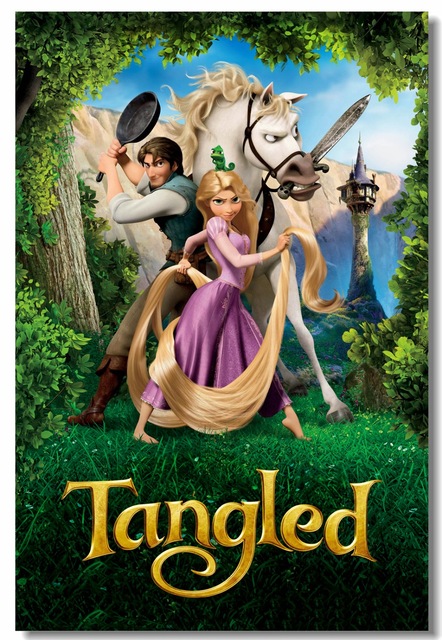
Byron Howard and Nathan Greno’s Disney animated classic, “Tangled” utilises the cinematic theory of window and frame within their narrative. Within Thomas Elsaesser and Matte Hagener’s text, ‘Film Theory: An Introduction through the Senses’, it suggests that window and frame provides three sources of focus for both the character and the viewer. It states that, “…the cinema as window and frame…is ocular-specula (i.e. conditioned by optical access), transitive (one looks at something), and disembodied (the spectator maintains a safe distance).” (T. Elsaesser, M. Hagener, 2010, p 14) “Tangled” protagonist, Rapunzel, is kidnapped by Mother Gothel as an infant for the purpose of maintaining her youthful appearance from the magic the child’s hair possessed. Rapunzel was locked away in a hidden tower with only a window to look out of. The window is framed with wooden beams and window shutters. This style of framing presents the two main conceptions presented by the film; entrapment and escapism. Rapunzel opens the shutters allowing her access to viewing the world outside her tower. This is contrasted when Mother Gothel closes the shutters, eliminating all transitive access to the world beyond the internal tower. When Rapunzel has access to looking through the window, she remains inside looking out, while the spectator is positioned outside the tower, looking towards the protagonist. This strategic positioning works to foreshadow Rapunzel’s escape from her solitude to join the viewer in the world outside her window. The protagonists transition from one side of the window to the other, opens up the world from isolation to adventure. Therefore, within Byron Howard and Nathan Greno’s animated film, “Tangled”, window and frame are used to convey two separate worlds; the isolation of the tower and the world beyond the window, as well as foreshadowing the eventual transition from one world to the other depicted through character and viewer positioning.
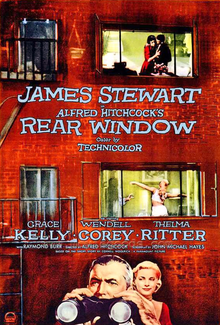
Alfred Hitchcock’s 1954 thriller film ‘Rear Window’, conveys the theme of voyeurism through the use of windows for the duration of the text. Hitchcock is known as the father of suspense. His iconic directorial filming techniques are well known to audiences around the world. One particular technique used in many of his films is treating the camera as the audience’s eye. He manoeuvres it around, directing their gaze onto the action taking place. Hitchcock uses windows within his work as a means of making his audience voyeurs or peeping Toms who witness intimate or criminal actions.
In the opening sequence of ‘Rear Window’, a small courtyard surrounded by apartment buildings is displayed. All windows into the character’s apartment rooms are opened, allowing the audience to peer in and see their behaviours without them knowing. As the camera pans around the buildings, it pulls into a window, revealing a room filled with extraordinary news photography and the protagonist, L.B ‘Jeff’ Jefferies’, who’s confined inside because of his broken leg. This sequence suggests to the audience that their gaze is being controlled from Jeff’s point of view. In Thomas Elsaesser and Matte Hagener’s text, “Film Theory: An Introduction through the Senses” it explores the idea of ‘Cinema as window and frame’. They posit that, “…window and frame, an inherit split between passive and active, between manipulation and agency, between witnessing and voyeurism, between irresponsibility and moral response that ‘Rear Window’ brilliantly enacts in all its dramatic potential and terrifying consequences.” (T. Elsaesser, M. Hagener, 2010, p 20) This concept conveys the narrative of ‘Rear Window’ as the protagonist wandering eye becomes witness to criminal behaviour, ultimately leading to dangerous consequences in the climax of the film. Therefore, being confined to his wheelchair, Jeff passively watches the active ventures of his neighbours through means of windows.
T. Elsaesser, M. Hagener, “Film Theory: An Introduction through the Senses”, 2010, pp. 14, 20
 Lauren's film analysis